|
|
|||||||||||
|
|
Melon de Bourgogne -- History
Article written 2006, Mike Lempriere last updated 20201012 The Melon de Bourgogne (MdB) winegrape was brought to America in the 1930's by Georges de Latour and was established at Beaulieu Vineyards (BV).[1] Andre Tchelistcheff recalled that de Latour obtained most of the wood for his imports from Solomon Nursery in Tomerry, France, so that is likely the source of this variety in the U.S.[1]
Tom Selfridge, then president of BV, claims that BV pulled out their
MdB in the early 1960's due to a grape virus, and some of those
cuttings went to
FPMS records include the following:[3] The grape has since been propagated via FPMS to other vineyards with the incorrect name of Pinot Blanc. There are different though related accounts of the discovery of this error. According to wine writer Steve Pitcher, the French ampelographer Dr. Pierre Galet discovered the error in 1980, upon visiting FPMS.[1] According to Ken Wright, Dr. Galet visited Monterey County approx. 1979 and observed "Pinot Blanc" vineyards that were actually MdB.[4] FPMS acknowledged the error in 1984 by notifying those who had purchased this material.[1] In 1983, Washington State University Irrigated Agricultural Research Extension Center (WSU IAREC) obtained Clone #2, UCD D7V14, and installed in their Motherblock (see photo above).[5] This has been propagated to Washington State growers by Inland Desert Nursery in Prosser, WA.[6] This is where Mike got his plants for Perennial Vintners. In 1985-1987 there was a 3 year trial in a Cornell program at the Geneva Research Station in New York. They apparently got it from the US Plant Introduction Station in Glendale Maryland.[7] Several California producers have produced a labelled "Melon de Bourgogne" wine, including Merlion and BV. Also, California has three wineries known to still produce wines from this grape, but labeled as Pinot Blanc, including Murphy-Goode Winery, Eagle Ridge Winery, and J. Fritz Winery.[1] At this writing we know of but three examples of this wine from American producers (labelled as "Melon de Bourgogne"); Panther Creek, Eugene Wine Cellars and Elemental Cellars, all from Oregon State. (Although Ken Wright (the man) was the pioneer of MdB in Oregon State, Ken Wright Cellars (the winery) has not produced a MdB wine; the vineyard source of the fruit stayed with Panther Creek where he did the initial work when he left to start his own winery).[3] Ken believes that Panther Creek was the first winery to produce an American MdB varietal wine that was actually labeled as such.[3] In 1966, David Lett left U. C. Davis and started The Eyrie Vineyards in Oregon state. He was caught in the mislabeled trap, and planted Pinot blanc, only to be informed that it was really MdB. However, he claims that the plants he got were really a mislabeled Chardonnay.[3] The name "Melon" itself has a bit of controversy associated with it in America. As of 08-Jan-1996, the BATF ruling determined that the full name of "Melon de Bourgogne" and the shortened name of simply "Melon" are both legal on wine labels from domestic producers. Although there are many examples where the terms "Melon" and "Muscadet" are used interchangably, the BATF did not find sufficient prior use in America to warrant allowing the use of the term "Muscadet", thus it is not legal to label a domestic wine as such.[8] In the big picture, this has actually worked out for the better as in the mid-2000's EU agreements are making it illegal to use European place names on products that did not originate there. Also please see Perennial Vintners who have planted the first MdB on the west side of the Cascades in Washington State. As of Oct-2006 the harvest was of excellent quality fruit with great numbers (sugar/acid/etc.). Also note that in 1999, Carole Meredith, a grape genetics expert authored a study which appeared in the journal Science that MdB (and 15 other winegrapes) are all derived from a crossing of Pinot and Gouais blanc.[9] (A Life With Grapes I can't view this, it's behind a paywall). Additionally, MdB is mentioned as a reference in the following study, which is probably fallout from the above study: The Parentage of a Classic Wine Grape Cabernet Sauvignon (local copy).
[1] The Story Of Clone 6 And Bell Wine Cellars;
(local copy of article) |
||||||||||
|
|
|||||||||||
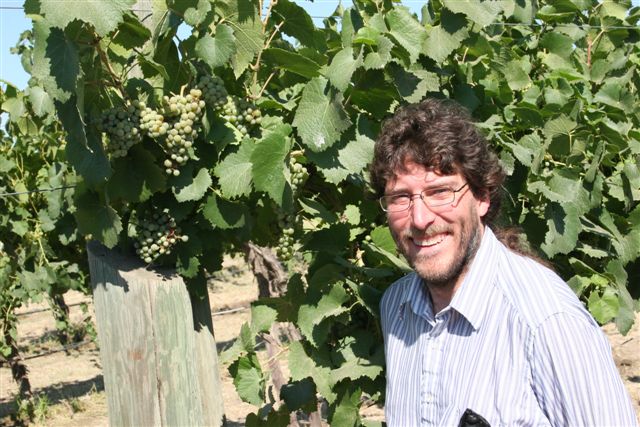 MikeL with Melon plant at WSU IAREC Motherblock 21-Aug-2005